
Your Gut Called—It Wants Credit for Your Hormones: Understanding the Gut-Hormone Connection
- Elizabeth Kuntz
- Apr 30
- 5 min read

When struggling with hormone imbalances or symptoms related to your hormones, it’s common to become fixated on “fixing your hormones.” The problem with this mindset is that hormones are typically the last domino to fall. What that means is we need to focus on the foundations of our health in order for hormones to function and thrive.
Hormones are chemical messengers, constantly communicating from one gland or organ to another. If that communication is off, there is always a reason. The true foundations of hormone health include nervous system regulation, gut health, blood sugar balance, proper nutrition, and mineral status. From there, the first dominos are cortisol (your stress response) and insulin (blood sugar regulation), followed by thyroid hormones (metabolism and energy), and finally sex hormones (reproductive health).
When you think about it, this hierarchy makes sense. If the body doesn’t feel nourished, safe, and balanced, reproduction is not a priority. Why would the body focus on creating and sustaining new life if the foundational systems are struggling?
One of the most overlooked—and most powerful—players in hormone health is the gut. Your gut isn’t just responsible for digestion. It’s deeply connected to how your body produces, regulates, and eliminates hormones. If your gut is off, your hormones will feel it (He et al., 2021). When gut health is compromised, hormone imbalances often follow.
Your Gut Helps Process and Clear Hormones
After hormones like estrogen and testosterone have done their job, the body needs to break them down and eliminate them efficiently. This process relies heavily on liver detoxification, proper digestion, and regular bowel movements.
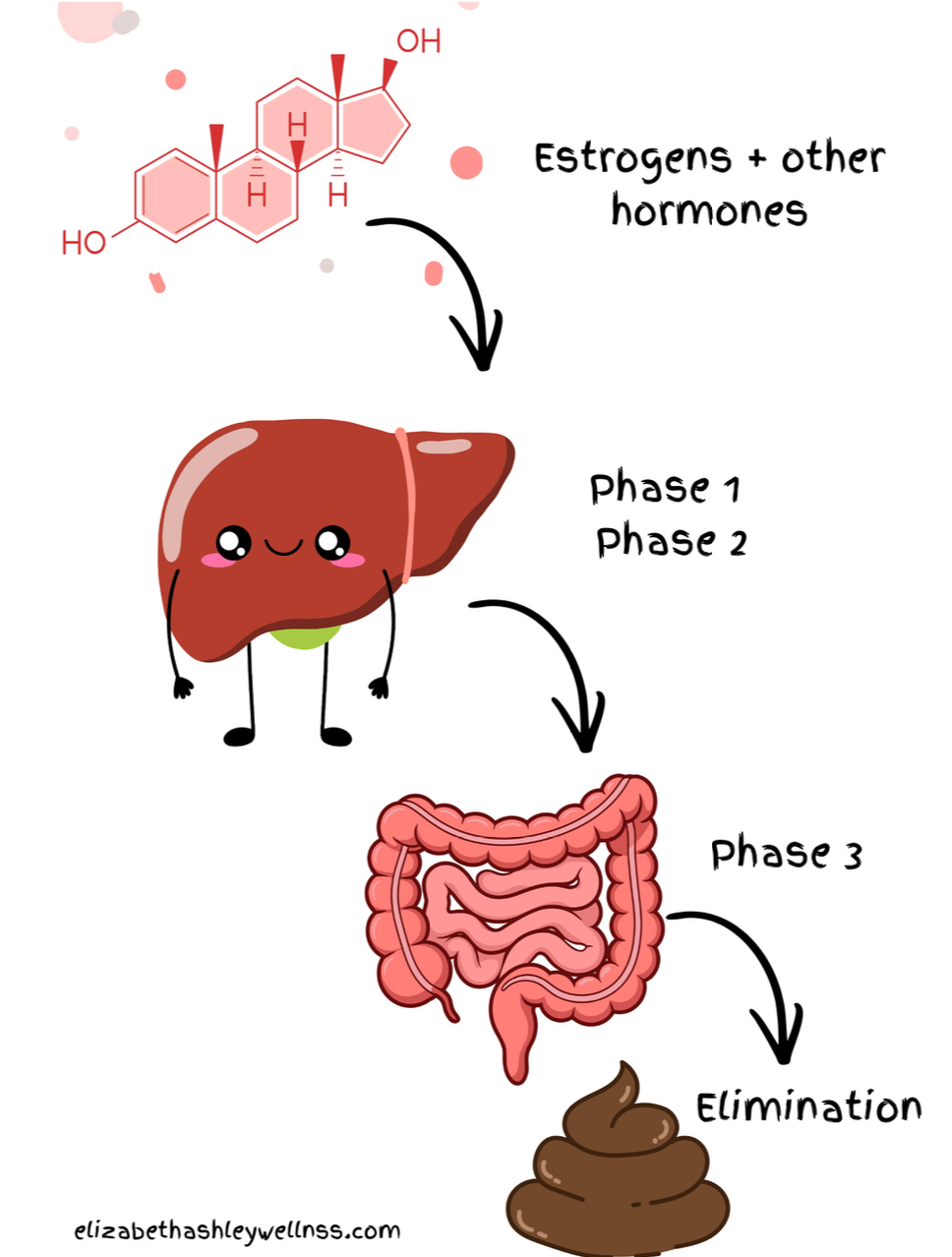
Think of the liver as your body’s filtration system. Once hormones have been used, the liver processes them so they can safely leave the body. This happens in two phases:
In Phase 1, the liver begins to chemically transform hormones into intermediate compounds. These compounds are essentially “unpacked” versions of the original hormone. However, they can actually be more reactive if they aren’t quickly moved into the next phase.
In Phase 2, the liver binds these compounds to specific nutrients, making them water-soluble and safe for excretion. From there, hormones are eliminated through bile (in the stool) or urine (Hu et al., 2023).
You can then think of your gut as the exit route for hormones—if traffic is backed up, hormones don’t leave the body the way they should. Instead, they can be reabsorbed and recirculated, contributing to symptoms like bloating, PMS, breast tenderness, acne, water retention, facial hair growth, and stubborn weight, particularly in the lower body.
Gut Bacteria Influence Estrogen Levels
Beyond elimination, the gut microbiome directly influences hormone levels—especially estrogen. A specific group of gut bacteria, known as the estrobolome, helps regulate how estrogen is metabolized and whether it stays active or gets properly excreted (Brighten, 2017). When the microbiome is balanced, this process works efficiently. When it’s disrupted, estrogen can become dysregulated—often contributing to what many experience as estrogen dominance.
In my practice, I use comprehensive stool testing, such as the GI-MAP, to assess markers like beta-glucuronidase. This enzyme provides insight into how well the body is breaking down and clearing estrogen. When elevated, targeted dietary and lifestyle interventions can help bring it back into balance.
Gut Inflammation Disrupts Hormone Signaling
Inflammation in the gut adds another layer to this connection.
When the gut lining is irritated or inflamed, it doesn’t stay localized—it impacts the entire body. Chronic gut inflammation can interfere with how hormones communicate with cells by affecting receptor sensitivity. Therefore, even if hormone levels appear “normal,” the body may not respond to them properly. This can also increase cortisol levels, placing additional stress on the hormonal system.
The Gut Regulates Blood Sugar (Which Controls Hormones)
The gut also plays a key role in blood sugar regulation, which is foundational for hormone balance.
How you digest and absorb carbohydrates and protein directly influences how stable your blood sugar is throughout the day. When blood sugar is constantly spiking and crashing, it can disrupt hormones like cortisol and insulin, impact ovulation, increase cravings, and make fat loss more difficult. A healthy gut supports more stable blood sugar patterns—which supports more stable hormones.
Neurotransmitters Made in the Gut Influence Hormones
Another often overlooked connection is the production of neurotransmitters in the gut. Chemicals like serotonin and dopamine are heavily influenced by gut health. While they are commonly known for their role in mood, they also play a significant role in hormone regulation.When gut health is compromised, neurotransmitter production can suffer, contributing to increased stress, anxiety, poor sleep, and downstream hormone imbalances (Dicks, 2022).
Nutrient Absorption = Hormone Production
Finally, the gut is essential for absorbing the nutrients your body needs to actually produce hormones.
You can be eating a nutrient-dense, whole-food diet, but if digestion is impaired, your body may not properly absorb those nutrients. Hormone production depends on key vitamins and minerals.

Without adequate absorption, the body simply doesn’t have the building blocks needed to maintain hormonal balance (Sifferlin, 2024). If digestion is compromised—whether from bloating, IBS symptoms, low stomach acid, or microbial imbalances—you may not be fully utilizing these nutrients, even if you are eating well.
How I Approach This With Clients
When I work with clients to support their hormones, we use functional lab testing to get a clear picture of how their gut is functioning.
From there, we focus on:
Providing the right nutrients to support hormone production
Supporting liver detoxification pathways
Ensuring proper elimination through consistent, healthy bowel movements
This allows us to address the root cause—not just manage symptoms.
In Conculsion
The gut and hormones are deeply interconnected. Symptoms like bloating, irregular cycles, PMS, fatigue, mood changes, and stubborn weight are rarely just “hormone issues” in isolation. More often than not, the gut is playing a significant role behind the scenes. Supporting gut health is one of the most effective and foundational ways to support hormones—not just temporarily, but at the root.
References:
Dicks L. M. T. (2022). Gut Bacteria and Neurotransmitters. Microorganisms, 10(9), 1838. https://doi.org/10.3390/microorganisms10091838
He, S., Li, H., Yu, Z., Zhang, F., Liang, S., Liu, H., Chen, H., & Lü, M. (2021). The Gut Microbiome and Sex Hormone-Related Diseases. Frontiers in microbiology, 12, 711137. https://doi.org/10.3389/fmicb.2021.711137
Hu, S., Ding, Q., Zhang, W., Kang, M., Ma, J., & Zhao, L. (2023). Gut microbial beta-glucuronidase: a vital regulator in female estrogen metabolism. Gut microbes, 15(1), 2236749. https://doi.org/10.1080/19490976.2023.2236749
Jolene Brighten, J. (2017, August 3). Gut health and hormones: Why is a healthy gut microbiome important for hormone balance. https://drbrighten.com/gut-hormone-connection/
Sifferlin, A. (2024, July 25). Can food really change your hormones? Time Magazine. https://time.com/7000236/can-food-change-your-hormones/


Comments